Open Source AI is Winning: How Community Models Are Outpacing Proprietary Giants
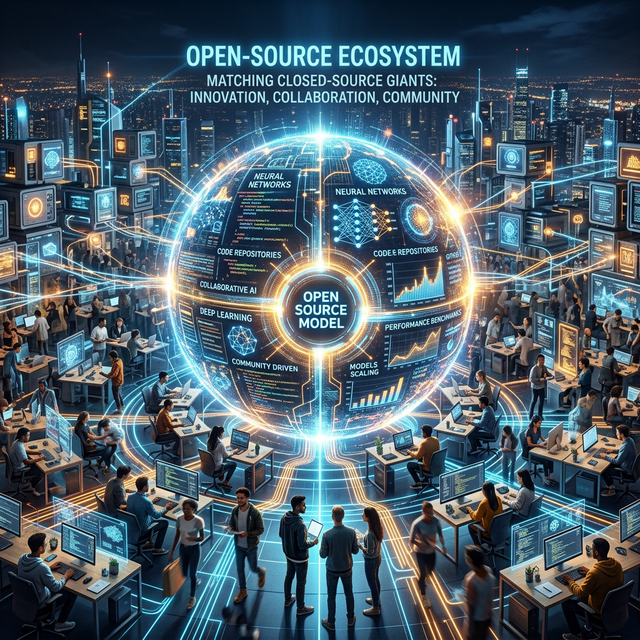
Open Source AI is Winning: How Community Models Are Outpacing Proprietary Giants
A remarkable shift is reshaping the AI landscape: open-source models are not just competing with proprietary systems—they're often surpassing them. What seemed impossible two years ago is now reality, and the implications are profound.
The Open Source Advantage
While companies like OpenAI and Anthropic guard their models behind APIs, the open-source community is building, sharing, and rapidly iterating on models that anyone can download, modify, and deploy.
Why Open Source is Accelerating
Collective Innovation
Thousands of researchers and developers worldwide contribute improvements, optimizations, and innovations. This distributed effort outpaces what any single company can achieve.
Transparency and Trust
Open models can be inspected, audited, and understood completely. Organizations handling sensitive data increasingly prefer this transparency over proprietary black boxes.
Customization Freedom
Developers can fine-tune open models for specific domains, languages, or tasks—creating specialized AI that outperforms general-purpose proprietary models for particular applications.
No Vendor Lock-In
Open-source models eliminate dependency on external providers. Your application won't break if a company changes pricing, terms, or discontinues a service.
Breakthrough Open Source Models
Meta's Llama 3 Family
Llama 3 models match or exceed GPT-3.5 and approach GPT-4 performance on many benchmarks. The 8B and 70B variants power countless applications worldwide.
Mistral AI's Models
Mistral 7B and Mixtral 8x7B demonstrate that small, efficient open models can deliver exceptional quality. Mixtral's mixture-of-experts architecture achieves remarkable performance-to-size ratios.
Alibaba's Qwen Series
Qwen models excel at multilingual tasks and coding, often outperforming larger proprietary models in specialized benchmarks.
Community Fine-Tunes
The community creates specialized versions: medical models, legal assistants, coding experts, and creative writing tools—all built on open foundations.
The Economic Impact
Democratizing AI Access
Open-source models eliminate the cost barrier. Students, researchers, and startups can access state-of-the-art AI without expensive API subscriptions.
Fostering Innovation
When anyone can experiment freely, innovation accelerates. Novel applications and techniques emerge from unexpected sources.
Challenging Monopolies
Open source prevents AI capability from concentrating in a few large corporations, distributing power more equitably across the technology landscape.
Technical Advantages
Reproducible Research
Scientists can verify results, build on previous work, and advance the field collaboratively. Proprietary models hinder scientific progress by hiding implementation details.
Privacy and Security
Running open models locally means sensitive data never leaves your infrastructure. For healthcare, finance, and legal applications, this is often a requirement, not a preference.
Offline Capability
Open models work without internet connectivity, enabling AI features in remote locations, secure facilities, or situations where cloud access is impractical.
Industry Adoption Patterns
Enterprises Embracing Open Models
Major companies are deploying open-source models internally, fine-tuning them on proprietary data to create competitive advantages.
Government and Research
Public institutions prefer open models for transparency, security, and independence from commercial providers.
Startups Building on Open Foundations
New companies leverage open models as building blocks, focusing resources on unique features rather than reinventing foundational AI.
Challenges and Solutions
Compute Requirements
Training large models requires significant resources, but the community pools efforts. Organizations like EleutherAI and Hugging Face coordinate large-scale training runs.
Quality Control
Not all open models are equal. Community benchmarks, leaderboards, and peer review help identify high-quality models.
Safety Considerations
Open models can be misused, but transparency enables better safety research. The community actively develops alignment techniques and safety measures.
The Future is Open
The trajectory is clear: open-source AI is not just viable—it's thriving. As models continue improving and the community grows, the gap with proprietary systems will narrow further, potentially disappearing entirely.
This isn't just about technology—it's about who controls the future of AI. Open source ensures that future belongs to everyone.
Join the open-source AI revolution with TernBase. Run powerful community models locally with complete freedom and control.